

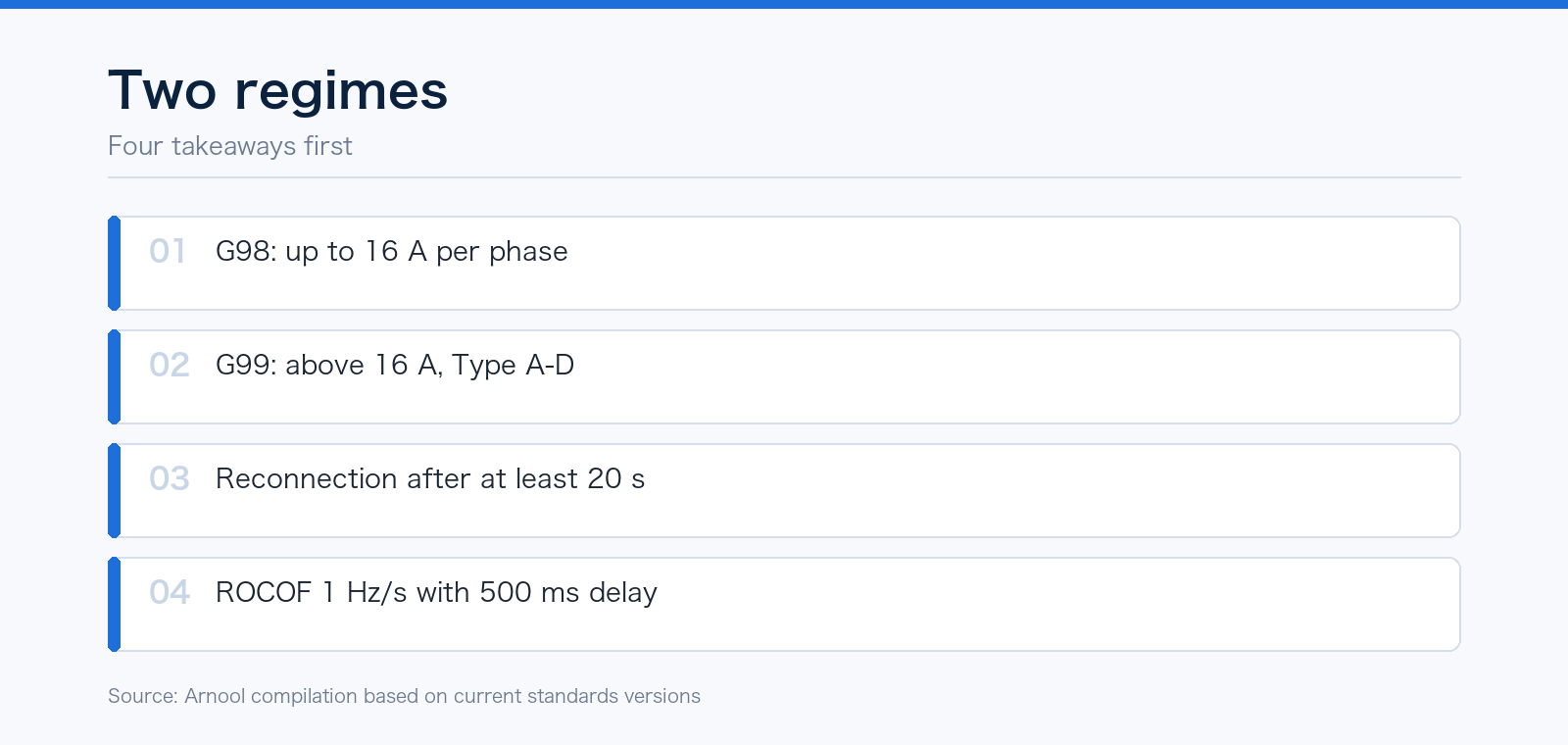
UK grid connection is defined by Ofgem engineering recommendations: G98 for small units (up to 16 A per phase) and G99 for the rest. Both are unusually prescriptive - protection thresholds, delays and reconnection times all come with numbers, leaving little room for interpretation during commissioning.
1. G98: the small-unit protection table
- Under-voltage: 184 V (230 V minus 20%), 2.5 s.
- Over-voltage Stage 1: 262.2 V / 1.0 s; Stage 2: 273.7 V / 0.5 s.
- Under-frequency Stage 1: 47.5 Hz / 20 s; Stage 2: 47 Hz / 0.5 s; over-frequency 52 Hz / 0.5 s.
- Loss of mains: ROCOF threshold 1.0 Hz/s, disconnection within 0.5 s (tested per BS EN 62116).
- Reconnection: at least 20 s after voltage and frequency recover.
The frequency ride-through bands are fine-grained: continuous 49.0-51.0 Hz, 90 min for 47.5-49.0 and 51.0-51.5 Hz, 15 min for 51.5-52.0 Hz and 20 s for 47.0-47.5 Hz. Implement these as a state machine, not as a few thresholds.
2. G99: classified by capacity
G99 defines Type A (0.8 kW to under 1 MW), Type B (1 to under 10 MW), Type C (10 to under 50 MW) and Type D (50 MW or more, or 110 kV and above). Type B and above require LVRT: hold 0.1 pu for 0-140 ms, then recover linearly to 0.85 pu between 140 ms and 2.2 s. RoCoF protection uses a 1 Hz/s threshold with a fixed 500 ms delay that may not be bypassed by cycle counting.
3. Two easy mistakes
- Reconnection timer: G99 requires proof that the unit does not reconnect at 1.16 pu, 0.78 pu, 47.4 Hz or 52.1 Hz, tested point by point.
- Anti-islanding method: G99 does not accept voltage vector shift and recommends RoCoF and/or power factor variation; the wrong method fails the test outright.
Keep G98/G99 settings as a parameter package separate from the EN 50549 baseline so one platform covers both the EU and the UK.
Related service: PV inverter grid-connection certification