

The EU has no single "European grid certificate". EN 50549 is the common upstream: national grid codes reference it and add local settings. So for EU projects, read EN 50549 first, then the national implementation.
1. Operating range and interface protection
Default frequency bands: 47.5-48.5 Hz for 30 min, 48.5-49.0 Hz for 30 min, 49.0-51.0 Hz continuous, 51.0-51.5 Hz for 30 min; continuous voltage 85%-110% Un. Stage 1 interface protection defaults: under-voltage 0.80 Un / 0.2 s, over-voltage 1.15 Un / 0.2 s, under-frequency 47.5 Hz / 0.2 s, over-frequency 51.5 Hz / 0.2 s. Anti-islanding is a separate requirement.
2. What A1:2023 changed
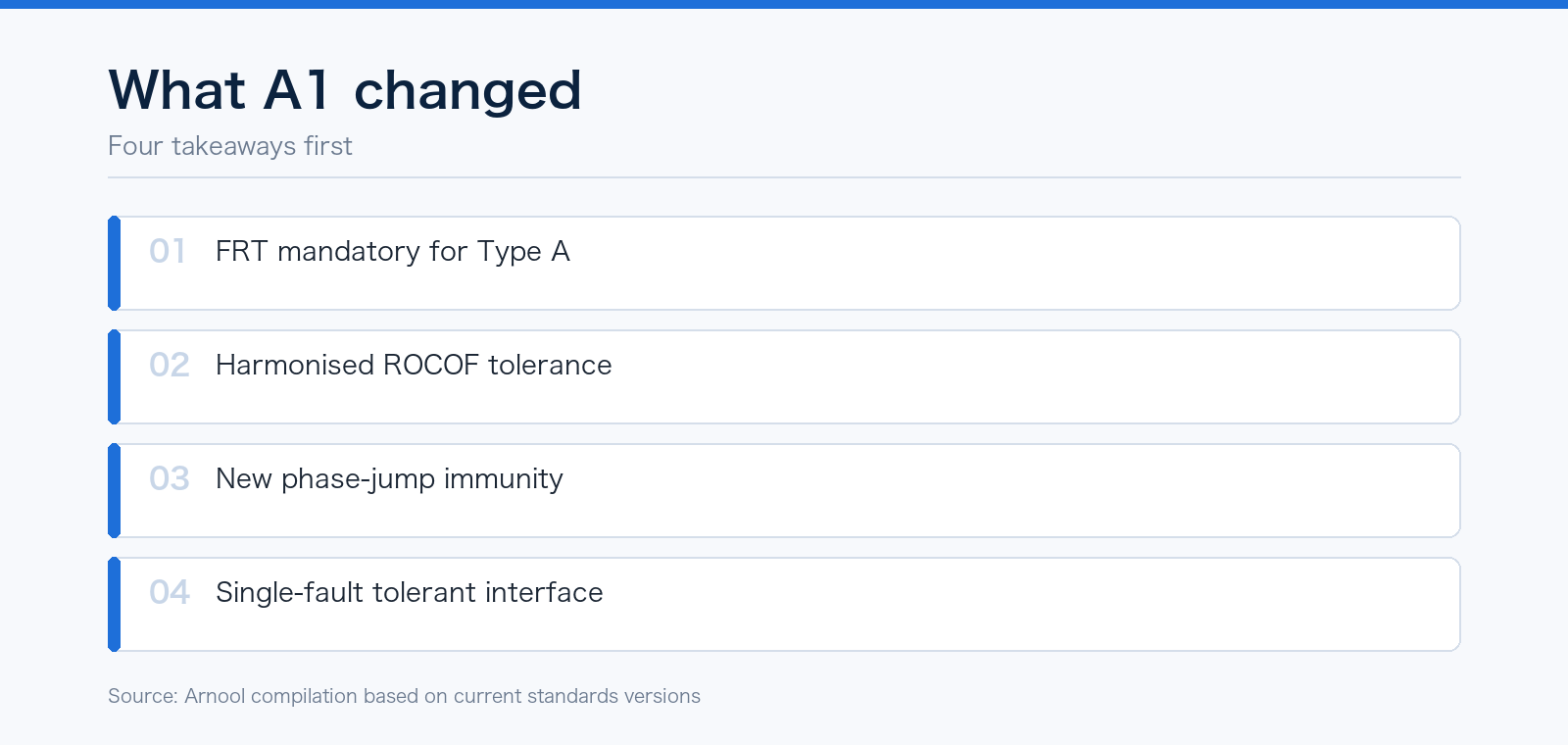
- FRT became mandatory for Type A, the single most impactful change for small distributed inverters.
- ROCOF harmonised across synchronous and non-synchronous technologies.
- Phase jump immunity added in EN 50549-2 (4.5.5), requiring dedicated phase-step testing.
3. Reactive and active response
LV connections need cos phi from 0.90 under-excited to 0.90 over-excited at the generation unit terminals, with Q setpoint, cos phi setpoint, Q(U) and cos phi(P) modes. On the active side, LFSM-O/U and voltage-dependent active power reduction are required to avoid overvoltage disconnection.
4. Single-fault tolerance: the hardware clause
Clause 4.13 requires the protection system and interface switch to tolerate a single fault. For transformerless PV inverters both switches must be load-break switches. This often surfaces during design review and cannot be fixed in firmware, so confirm it at selection stage.
For multi-country EU projects, use EN 50549 as the baseline and overlay national setting packages (VDE-AR-N 4105, CEI 0-21) to avoid re-testing per country.
Related service: PV inverter grid-connection certification