

In China, grid-connection discussions always come back to GB/T 37408-2019. Many companies treat it as a test list, but the clauses that actually block projects are the ones with specific numbers in Clause 7.
1. Reactive power: the Type A and Type B boundary
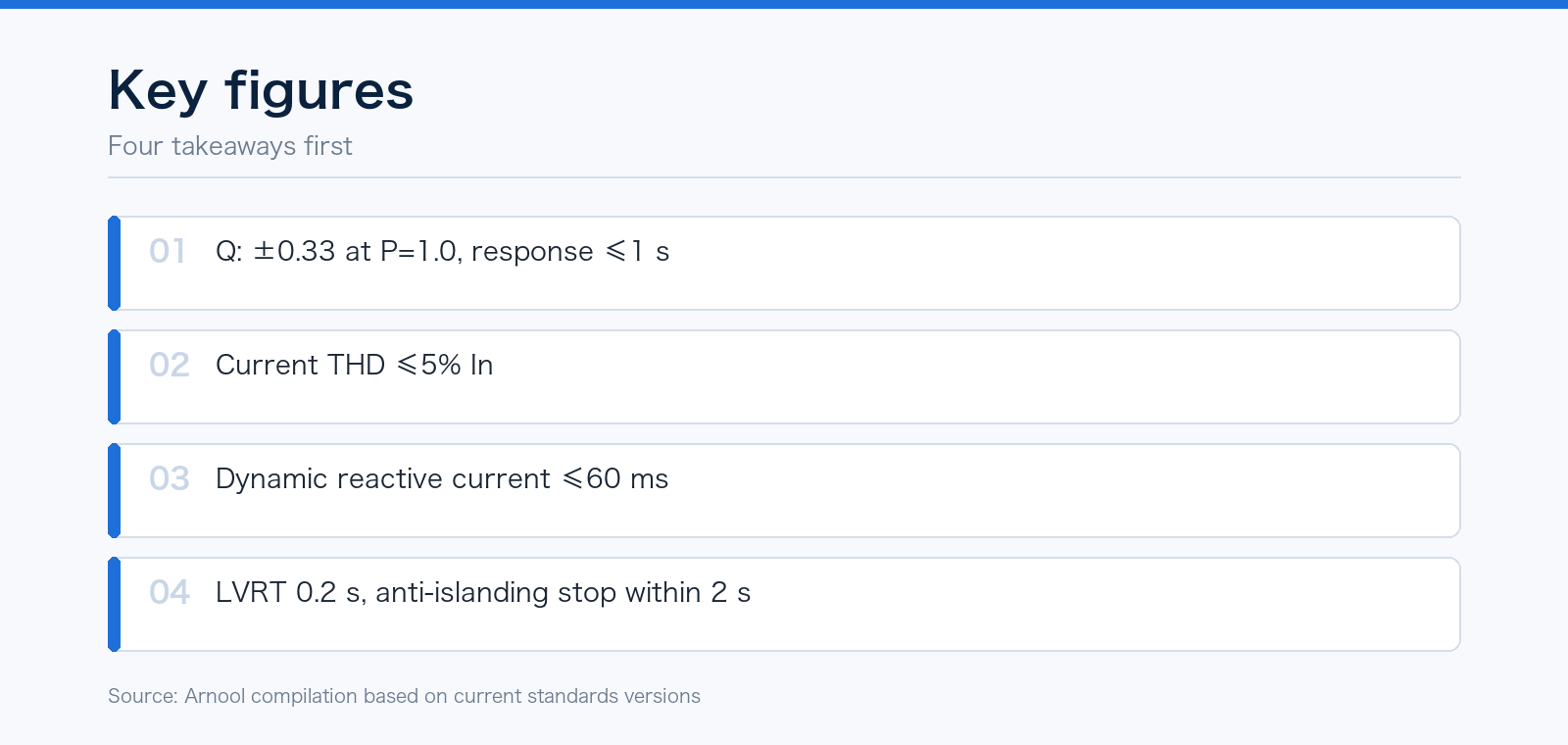
Type A must be adjustable inside the solid rectangle (Q up to ±0.33 at P=1.0, ±0.48 at P=0); Type B follows the shaded area tied to active output. Control modes must cover voltage/reactive, constant power factor and constant reactive power, with online switching and command following. Control error within 1% of rated active power and response within 1 s are the two numbers most often challenged during commissioning.
2. Power quality: four hard limits
- Negative-sequence current unbalance within 2% (short-term 4%).
- Current THD within 5% In, per-order limits in Table 16.
- Voltage fluctuation and flicker per GB/T 12326.
- DC component within 0.5% of rated AC current.
3. Ride-through and operating range
During LVRT the inverter must inject dynamic reactive current, and absorb it during HVRT, with response within 60 ms. The unit must operate normally at 0.9-1.1 p.u. voltage, run continuously from 48.5 to 50.5 Hz and for at least 3 minutes between 50.5 and 51.0 Hz.
4. Protection and reconnection
Anti-islanding is optional for Type A and mandatory for Type B; the inverter must stop feeding within 2 s and wait 20 s to 5 min before reconnecting. In many overseas codes reconnection delay is a separate clause, which makes it easy to miss in Chinese projects.
Note that GB/T 37409 and NB/T 32004 are normally used together with GB/T 37408 to define the test scope, so align all three before sampling.
Related service: PV inverter grid-connection certification