

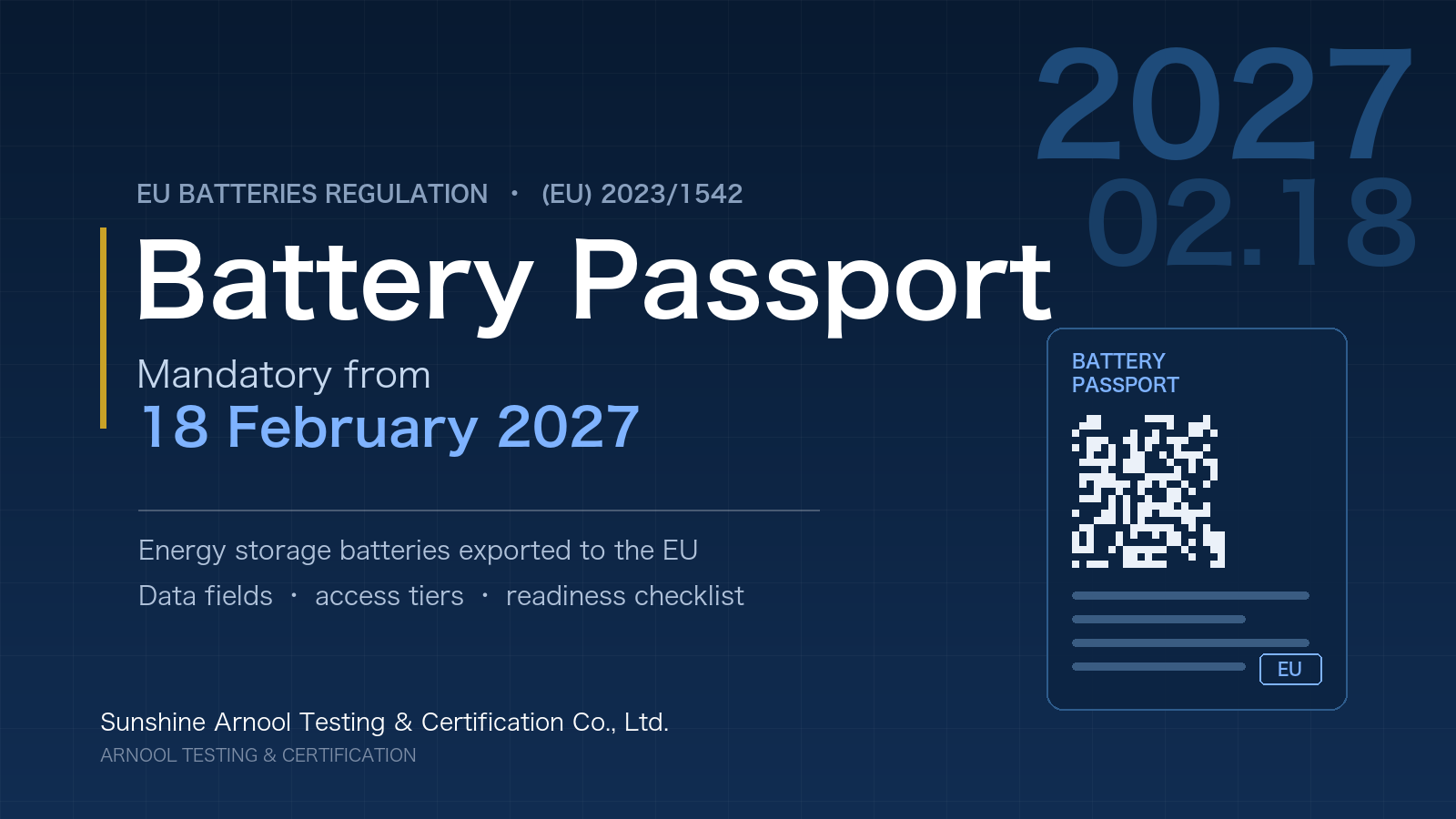
If you export energy storage systems to the EU, one date belongs in your project plan: 18 February 2027. From that day, industrial batteries with a capacity above 2 kWh must carry a digital battery passport before being placed on the EU market or put into service. Most storage racks and cabinets fall into this category.
This is not a voluntary document. It is mandated by Article 77 of the EU Batteries Regulation (EU) 2023/1542. The deadline is more than a year away, but the work starts earlier — the underlying data is spread across cell suppliers, BMS, system integrators and recyclers.
01 Legal basis and timeline
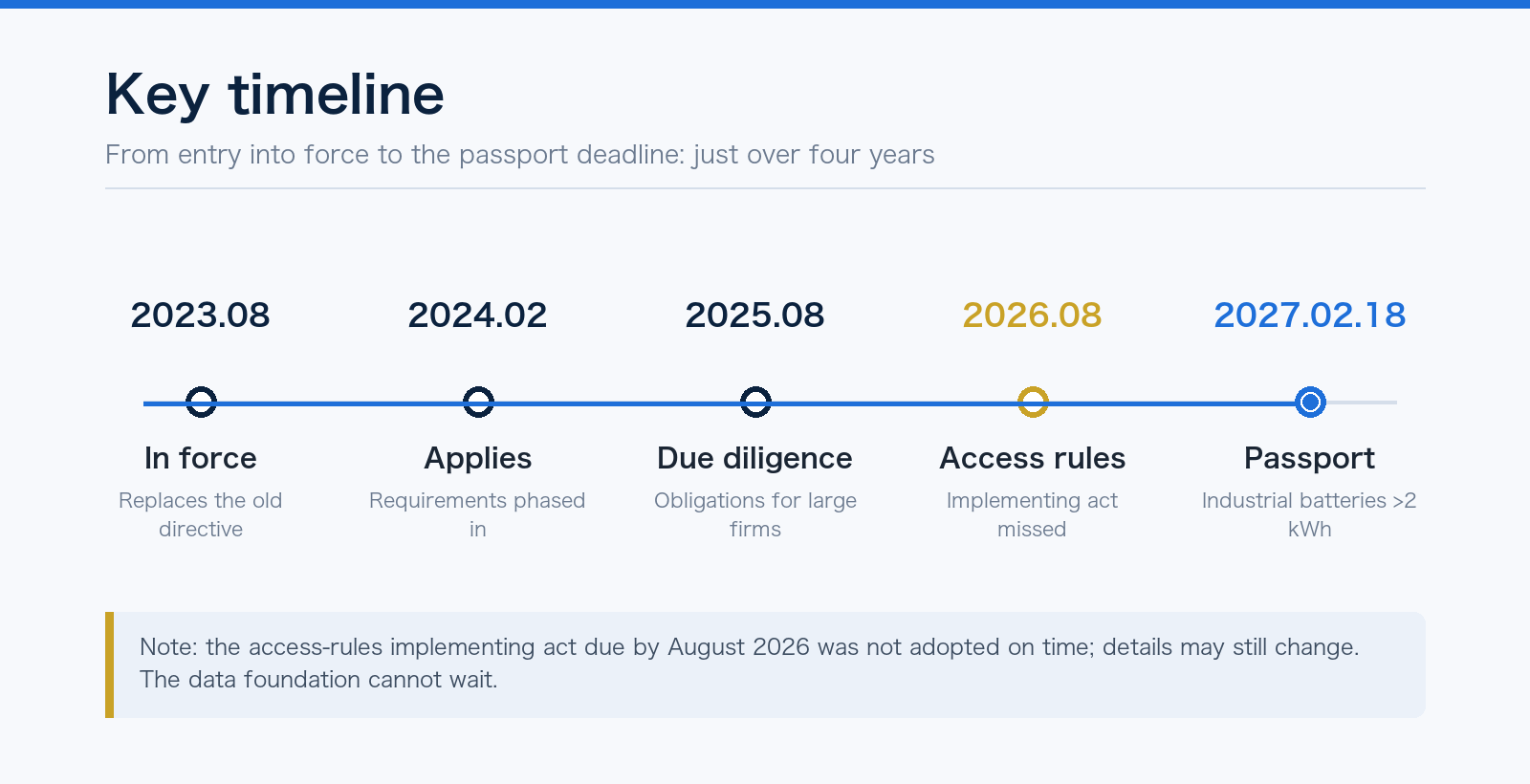
Regulation (EU) 2023/1542 entered into force on 17 August 2023 and has applied since 18 February 2024, replacing the old Batteries Directive 2006/66/EC. It introduces staged requirements on carbon footprint, recycled content, performance and durability, due diligence, labelling and the digital battery passport. The passport becomes mandatory on 18 February 2027.
Product safety certification (IEC 62619, UL 9540) and the battery passport are separate tracks: the former proves the product is safe, the latter proves the battery identity and information are traceable and verifiable. They usually run in parallel.
02 Scope
Article 77 covers LMT batteries, industrial batteries above 2 kWh and EV batteries. Storage racks built on LFP or NMC cells generally qualify as industrial batteries above 2 kWh, so exporters can hardly avoid it.
A common mistake is to think of the passport as a cell-level document only. The passport is issued for the battery placed on the market, so system integrators must obtain cell-level data upstream and deliver cabinet-level passports downstream. One missing link breaks the chain.
03 What the passport actually is
The passport is an electronic record tied to a unique battery identifier and accessed through a QR code on the battery. The regulation requires the QR code and identifier to follow the ISO/IEC 15459 series and to use open, interoperable standards to avoid vendor lock-in.
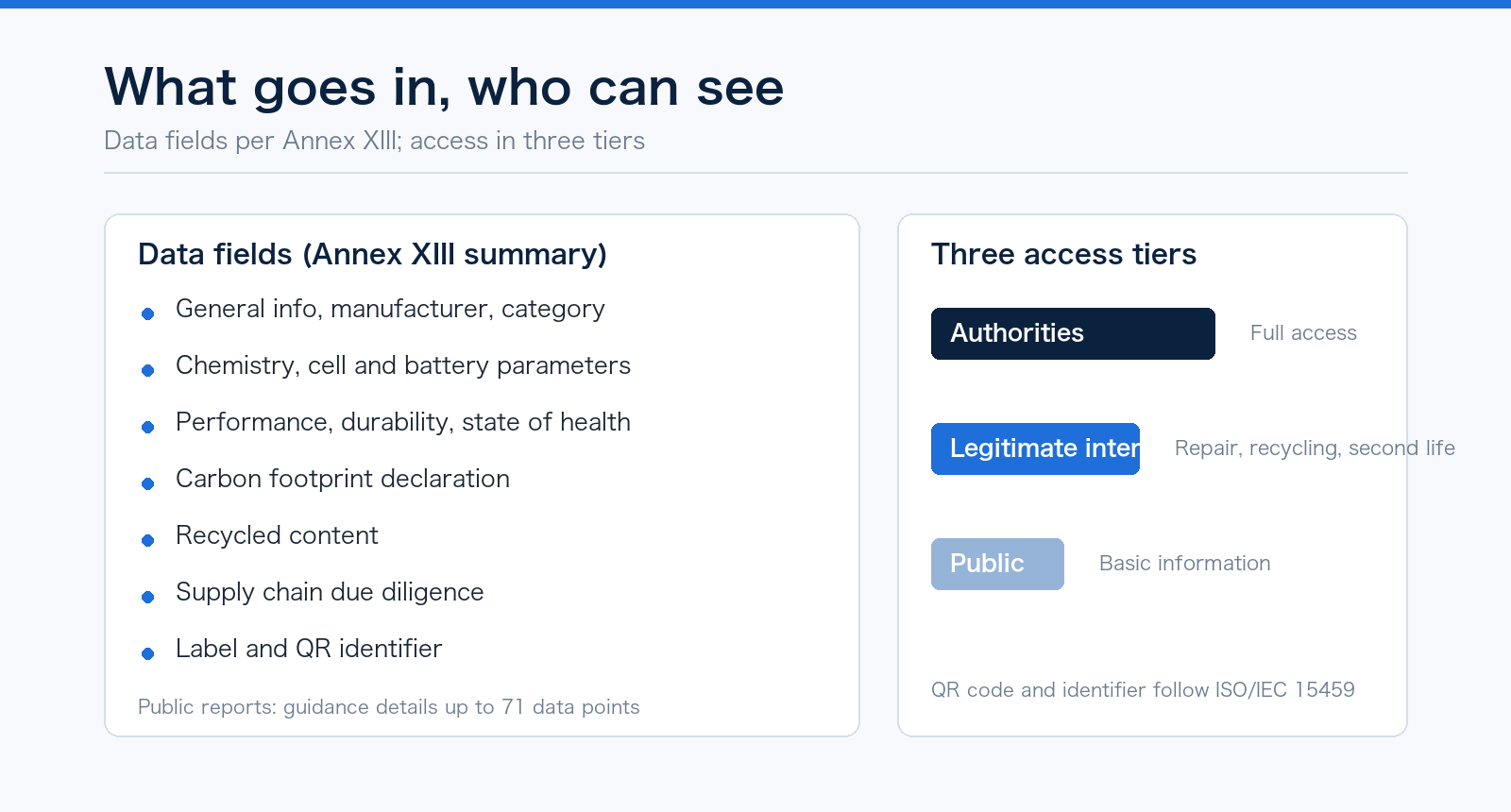
Access is tiered: the public sees basic information; parties with a legitimate interest (repairers, recyclers, second-life operators) access deeper data; authorities have full access. Data fields follow Annex XIII and typically include:
- general information, labelling, manufacturer, battery category and chemistry;
- performance and durability data, state of health;
- carbon footprint declaration and recycled content;
- supply chain due diligence information.
04 A variable worth watching: access rules are still pending
The Commission was expected to adopt an implementing act by 18 August 2026 setting out access rules and format details. Public analyses by law firms and compliance providers indicate the act was not adopted on time, so technical details may still change.
The lesson is not to wait: system details can wait, the data foundation cannot. Chemistry, carbon footprint, recycled content and supply chain data all require collection and verification mechanisms that take months to build.
05 Readiness checklist
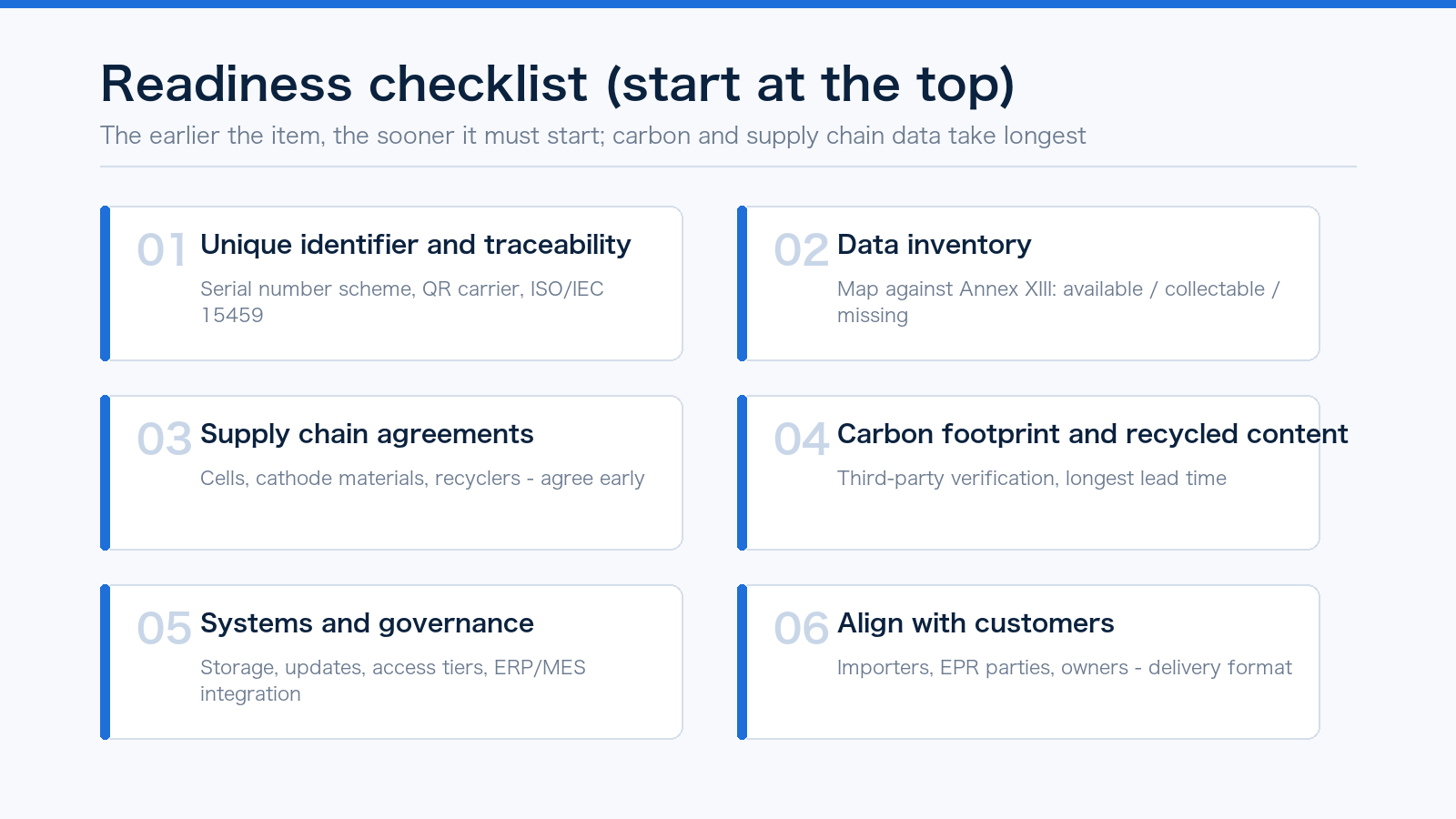
- Define the unique battery identifier and traceability scheme, aligned with ISO/IEC 15459;
- Map data against Annex XIII and classify each item as available, collectable or missing;
- Secure supply chain data agreements with cell, cathode and recycling partners;
- Start carbon footprint and recycled content verification first — they take the longest;
- Build storage, update and access-tier governance, integrated with ERP/MES;
- Align with EU customers, EPR responsible parties and importers on delivery format.
06 Common misconceptions
- Treating the passport as just a QR code — the code is an entry point, the data system is the substance;
- Planning to start in 2027 — carbon and supply chain verification usually takes 6–12 months;
- Confusing CE marking or battery safety certification with the passport;
- Focusing only on the system integrator — data flows through the chain and cannot be filled in at the end.
07 What it means for storage exports
In the short term it is an added compliance cost; in the medium term it becomes a qualification item in tenders and customer audits, as European owners, EPCs and financiers increasingly require traceable battery information. Companies with a working data system gain a differentiation advantage.
Final technical details remain subject to the forthcoming implementing act. This article is based on the public regulation text and industry analyses and is intended for project planning.
Sources
- Regulation (EU) 2023/1542: eur-lex.europa.eu
- European Commission, batteries topic: environment.ec.europa.eu
- Analysis on the pending access-rules implementing act: Taylor Wessing
- Battery Passport Content Guidance: systemiq.earth
Related service: New energy export certification (EV charging, PV inverters, energy storage).