
Export-market testing and certification for energy storage systems: UL 9540 / UL 9540A / NFPA 855 in North America, IEC 62619 / IEC 63056 / IEC 62933-5-2 / VDE-AR-N 4105 in Europe, and GB 44240-2024 in China, covering cells, racks, PCS, BMS and cabinet level.
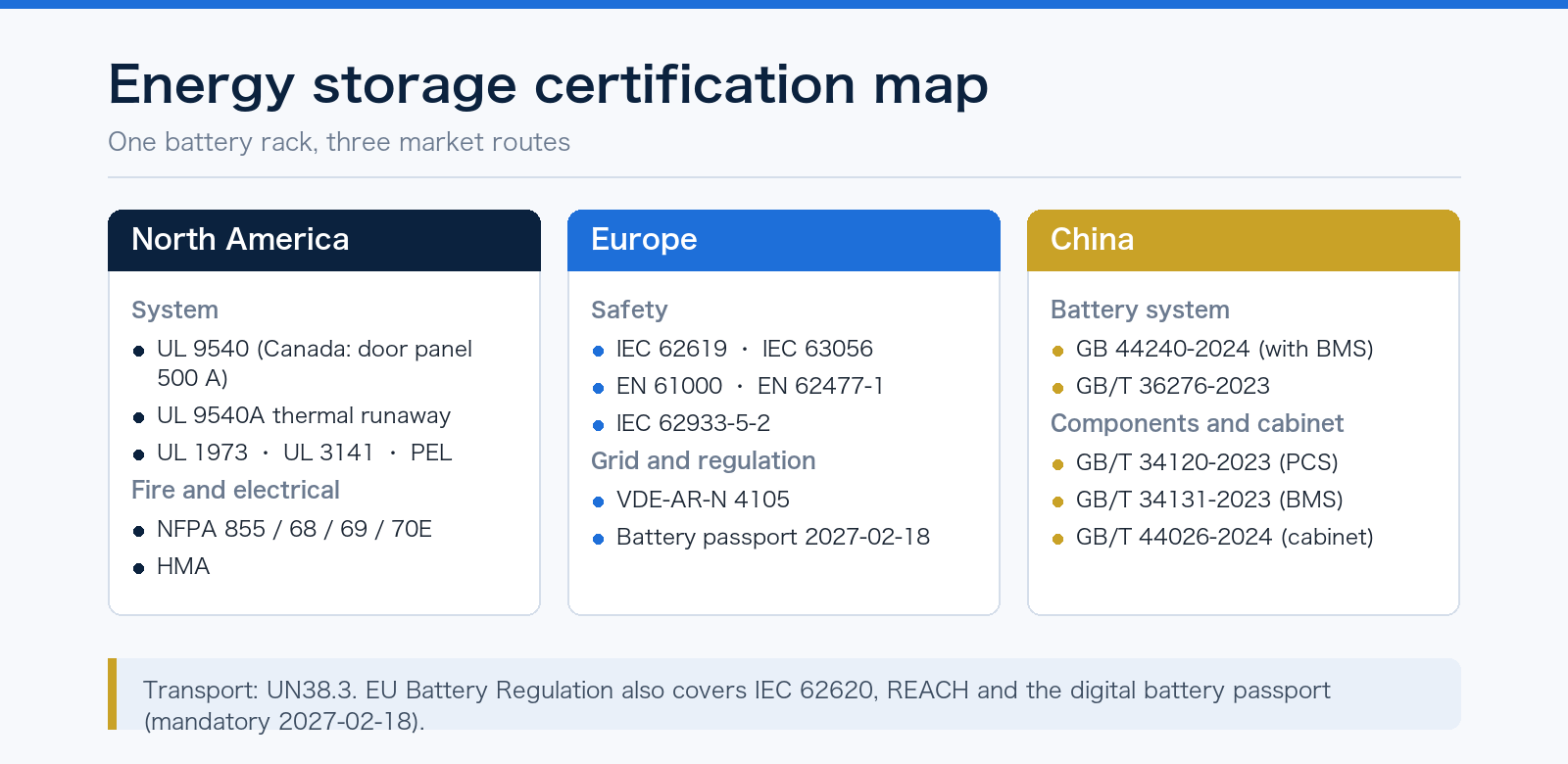
Energy storage certification is a chain rather than a single test: cells, battery racks, system level, grid connection and transport. The applicable standards and review focus differ by market, so the sequence should be planned before sampling to avoid duplicate testing.
North America
UL standards plus NFPA fire codes form the main line, with system integration and thermal runaway under the closest scrutiny.
System and components
- UL 9540: safety of energy storage systems and equipment, assessed at system integration level. For Canada, an additional door-panel 500 A current test is required (no voltage requirement), focusing on the door hinge conduction path.
- UL 9540A: thermal runaway propagation. If testing is limited to cell/module level, an additional fire-resistance assessment under NFPA 855 is required, or the project can go directly to large-scale fire testing.
- UL 1973: battery safety at cell and module level.
- UL 3141: power control requirements for energy storage, used together with PEL.
- PEL (Power Export Limitation): limits power export to the grid, the successor to reverse-power prevention requirements.
- UN38.3: lithium battery transport safety, a prerequisite for shipping.
Fire and electrical safety
- NFPA 855: installation standard for stationary energy storage, driving system-level testing, separation and fire protection.
- NFPA 68: explosion venting (passive deflagration venting).
- NFPA 69: explosion prevention and active ventilation.
- NFPA 70E: electrical safety in the workplace and arc flash protection.
- HMA (Hazard Mitigation Analysis): built on UL 9540, NFPA 68 and NFPA 69 results.
Europe
Safety
- IEC 62619: safety of industrial lithium batteries (cells and battery systems).
- IEC 63056: secondary batteries for battery energy storage systems.
- EN 61000: electromagnetic compatibility.
- EN 62477-1: safety of power electronic converter equipment, commonly applied to PCS.
- IEC 62933-5-2: safety of grid-integrated energy storage systems.
Grid connection
- Germany: VDE-AR-N 4105 for low-voltage grid-connected generation.
Battery regulation and materials
- IEC 62620: performance of industrial lithium batteries.
- UN38.3: transport safety.
- REACH: chemical registration and restriction compliance.
- Battery passport: required by the EU Battery Regulation, mandatory from 2027-02-18; data and traceability should be prepared in advance.
China
- GB 44240-2024: battery systems with BMS.
- GB/T 36276-2023: lithium-ion batteries for electrical energy storage.
- GB/T 34120-2023: PCS technical requirements.
- GB/T 34131-2023: BMS technical requirements.
- GB/T 44026-2024: energy storage cabinet requirements.
Planning the test sequence
Proceed market first, then system, then components, then transport and grid connection. System-level certification (UL 9540 / IEC 62933-5-2) defines most test items; whether UL 9540A stops at cell level or goes to large-scale fire testing, and whether NFPA 855 fire resistance applies, materially affects schedule and sample count. UN38.3 and grid tests can run in parallel with system testing to shorten the overall timeline.