

Two documents are often confused in the US market: IEEE 1547-2018 defines technical requirements, while UL 1741 SB defines how compliance is demonstrated. The accurate answer to "can we enter the US" is "can we obtain UL 1741 SB certification", not "do we meet 1547".
1. Structure of IEEE 1547-2018
- Clause 4: general specifications, configurable performance categories, PCC definition.
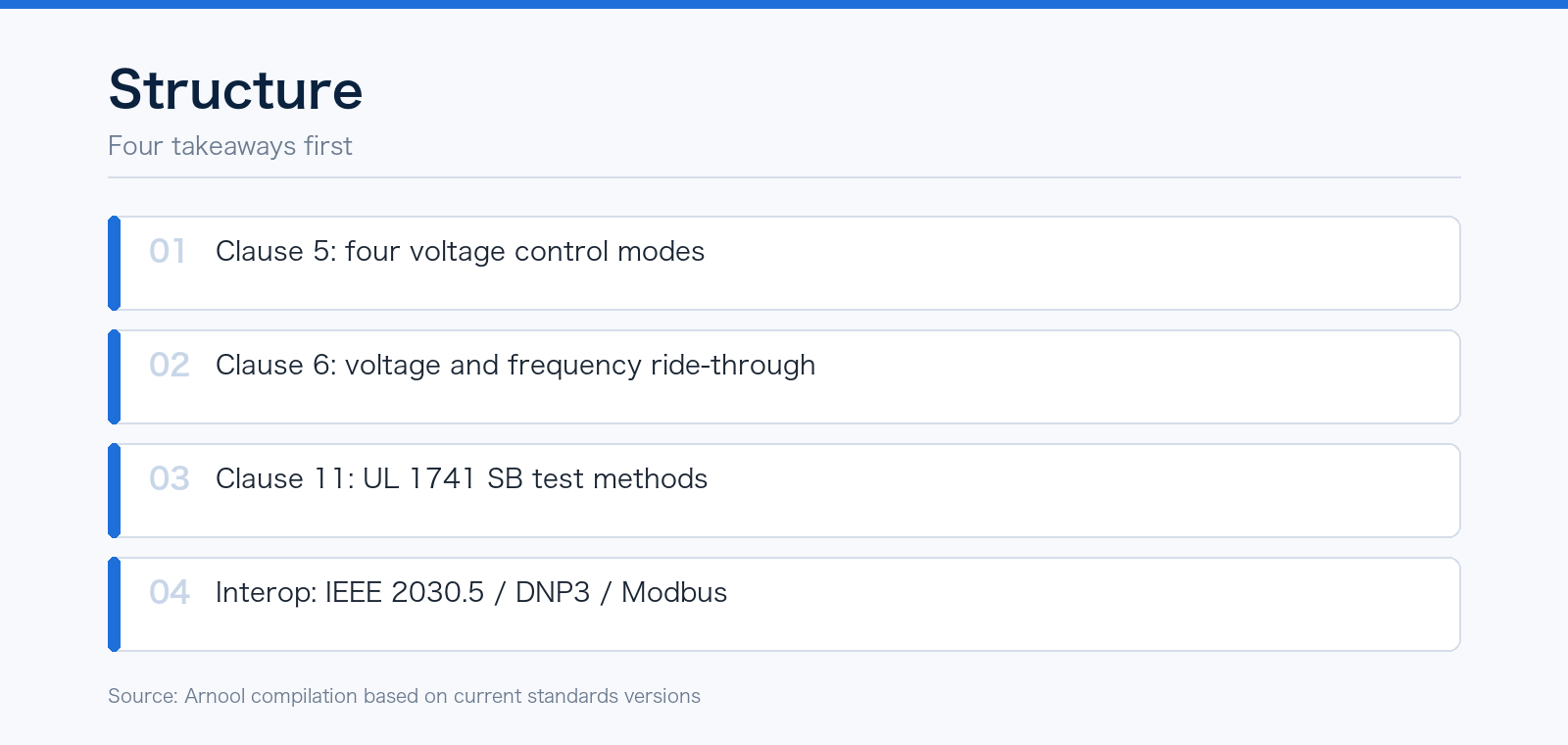
- Clause 5: reactive power and voltage/power control in four modes - constant PF, Volt-Var, Watt-Var, constant Q.
- Clause 6: voltage and frequency ride-through, the core of interconnection testing.
- Clauses 7-8: power quality, islanding and black start.
- Clauses 9-10: secondary networks, interoperability and information exchange.
- Clause 11: test and verification framework, implemented by UL 1741 SB.
2. What UL 1741 SB tests
SB covers LVRT/HVRT, LFRT/HFRT, Volt/VAR and Watt/VAR, Volt/Watt and Frequency/Watt, anti-islanding, soft-start reconnection, ROCOF tolerance, dynamic voltage support and communication interoperability. UL 1741 SB is a prerequisite for most North American utilities; without it an interconnection application cannot even be filed.
3. Why interoperability matters
US states are pushing DER aggregation and grid services, so utilities need to read and dispatch inverters remotely. Clause 10 mandates at least one standard protocol (IEEE 2030.5, DNP3, SunSpec Modbus) plus standardised nameplate, configuration and monitoring information. Chinese manufacturers often lose points here: the power behaviour is fine but the communication object mapping does not match, blocking commissioning.
4. Common failure points
- Volt-Var defaults differ from utility requirements and are not field-configurable.
- Active power recovery after FRT is faster than the allowed ramp rate.
- ROCOF tolerance window or measurement method does not match the test.
- Communication implemented "so it connects" but not per the standard object model.
A pre-test focused on FRT and communications usually saves one firmware rework cycle.
Related service: PV inverter grid-connection certification