

Germany separates medium and low voltage connection rules; VDE-AR-N 4105 covers low voltage. The 2026 edition keeps the 2018 clause structure but provides a clearer simplified route for small generation and storage units (EZSE).
1. Scope and simplified route
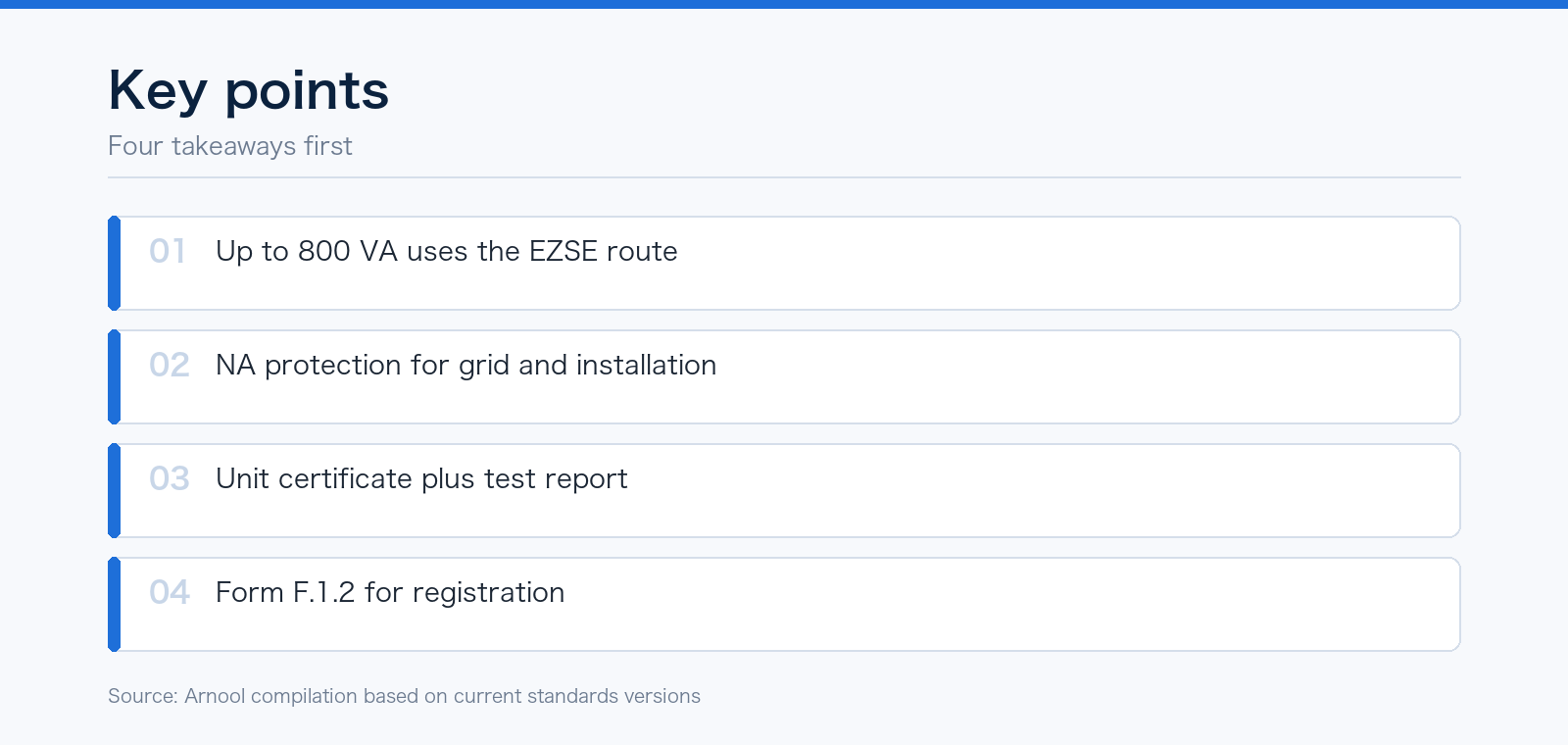
Generation, storage or DC-coupled units with rated apparent power up to 800 VA can use the simplified connection route with Form F.1.2. Larger projects follow the regular process with a full proof of compliance. The explicit EZSE concept in the 2026 edition shows German operators now treat "small storage plus PV" as its own category.
2. NA protection
NA protection (grid and installation protection) is the technical core: protection devices and settings (6.5), and the combination of generator switch and isolation device for half-indirect measurement (6.4.2). Compared with EN 50549 interface protection, NA protection focuses more on measurement point location and switch combinations, which is checked closely during commissioning.
3. Proof of compliance
- Generator behaviour on the grid (5.7): active/reactive control, ride-through, frequency and voltage adaptability.
- Proof of electrical characteristics (9): unit certificate, declaration of conformity, test reports.
- Connection conditions and synchronisation (8.3).
4. Common rejection reasons
Most German rejections are document issues, not test failures: unit certificate not matching the actual firmware, test report not covering the target power range, or Form F.1.2 details inconsistent with the nameplate. A three-way consistency check before sampling saves more time than an extra test.
State-level network operators add their own conditions, so confirm with the local Netzbetreiber for each project.
Related service: PV inverter grid-connection certification