

New Lighting Standards: Major Changes
ARNOOL

In the lighting industry, updates to standards always have far-reaching implications.
IEC 60598-1:2024 and EN IEC 60598-1:2024/A11:2024 have both been published. Of these, EN IEC 60598-1:2024/A11:2024 will become mandatory on December 31, 2025, and products that have already been certified must complete the necessary modifications by December 31, 2027, at the latest. While the time allotted for relevant companies to adapt and adjust may seem ample, it is in fact tight; every stage involved in the production, sales, and certification of luminaires requires advance planning.
1
Major Technical Changes
1. Adoption of a new chapter structure to comply with Part 2 of the ISO/IEC Directives.
2. Addition of Annex V to facilitate comparison with the 9th Edition (2020).
3. Revised the requirements for SPDs and SPCs in 7.32.
4. Revised the terms “live parts” and “moving parts” to align with the definitions in IEC 60050-195.
5. Revised the mechanical stress requirements for conductors in 7.14.2.
6. Revised item 4 of 14.5.2 to include control devices.
7. Revise 9.2.1 (Grounding) to delete the word “permanent.”
8. Revise Annex N: Grounding continuity test duration.
9. Revise 7.11.4; 7.14.1; Table 22 (14.4.3): Introduce requirements for magnetic mounting.
10. Add Appendix W, applicable to battery-powered luminaires.
11. Clarify the marking requirements regarding the nature of the power source in Chapter 6.
12. Add 7.31.5: Additional requirements for luminaires using controllable control devices that provide SELV output.
13. Revised 6.4.16: Information to be provided for luminaires with protective grounding current > 10 mA.
14. Revised provisions regarding serviceable, non-user-serviceable, and non-serviceable parts.
15. Amendment to Appendix D: Requirements for wind guards.
16. Amendments to 8.2.1 and 13.2.1: Address inconsistencies regarding voltage range limits.
17. Revise the installation requirements for loop-in sections in 9.2.10.
18. Update references to the IEC 61058 and IEC 60669 series.
19. Revise the section on photobiological safety.
20. Add Section 6.3.27 for the marking of power outlets.

2
Impact on Certification and Testing
Annex O lists the major changes that may affect certification, involving the following subclauses:
1. 7.32: For SPDs and SPCs, certification must focus on whether they comply with the new requirements.
2. 7.14.2: For special cables or wires, certification testing must strictly verify compliance with new requirements, such as mechanical stress on conductors.
3. 14.5.2 (Abnormal Operating Conditions): This includes electronic step-down converters, which must be tested and certified for performance under abnormal conditions.
4. Requirements for Magnetic Mounting: For luminaires using magnetic mounting, ensure that the installation method complies with the standard.
5. Requirements for Battery-Powered Luminaires: Certification testing—from battery selection to overall luminaire performance—must be conducted in accordance with the new Appendix W.
6. Additional Requirements for Controllable Control Devices: For luminaires that comply with Clause 7.31.5, their controllable control devices must pass the corresponding certification.
7. Information requirements for protective earth current > 10 mA: Relevant luminaires must accurately provide information in accordance with the requirements of Clause 6.4.16.
8. Provisions for Serviceable Components: During certification, it must be determined whether the luminaire’s serviceable components comply with the new provisions.
9. Requirements for Luminaires with Switches: The requirements for switches are more stringent; certification testing must be flawless.
10. Marking of the Main Socket: In accordance with Section 6.3.27, ensure that the marking on the main socket complies with the standard.
3
Development Plan for the New Standard
The content of the document will remain unchanged until the stabilization date (2027), at which point it will be reaffirmed, withdrawn, or revised. This means that for the foreseeable future, companies will have a relatively stable regulatory environment for production and certification; however, they must remain vigilant regarding developments in 2027 and prepare in advance.
Summary:
The release of the new lighting standards presents both challenges and opportunities. Companies need to stay informed about changes to the standards and adjust their production and certification strategies to continue providing the market with high-quality, compliant lighting products under the new regulatory framework.
#If you need services related to lighting products, please feel free to contact us!
ARNOOL
Suzhou Arnool testing and certification
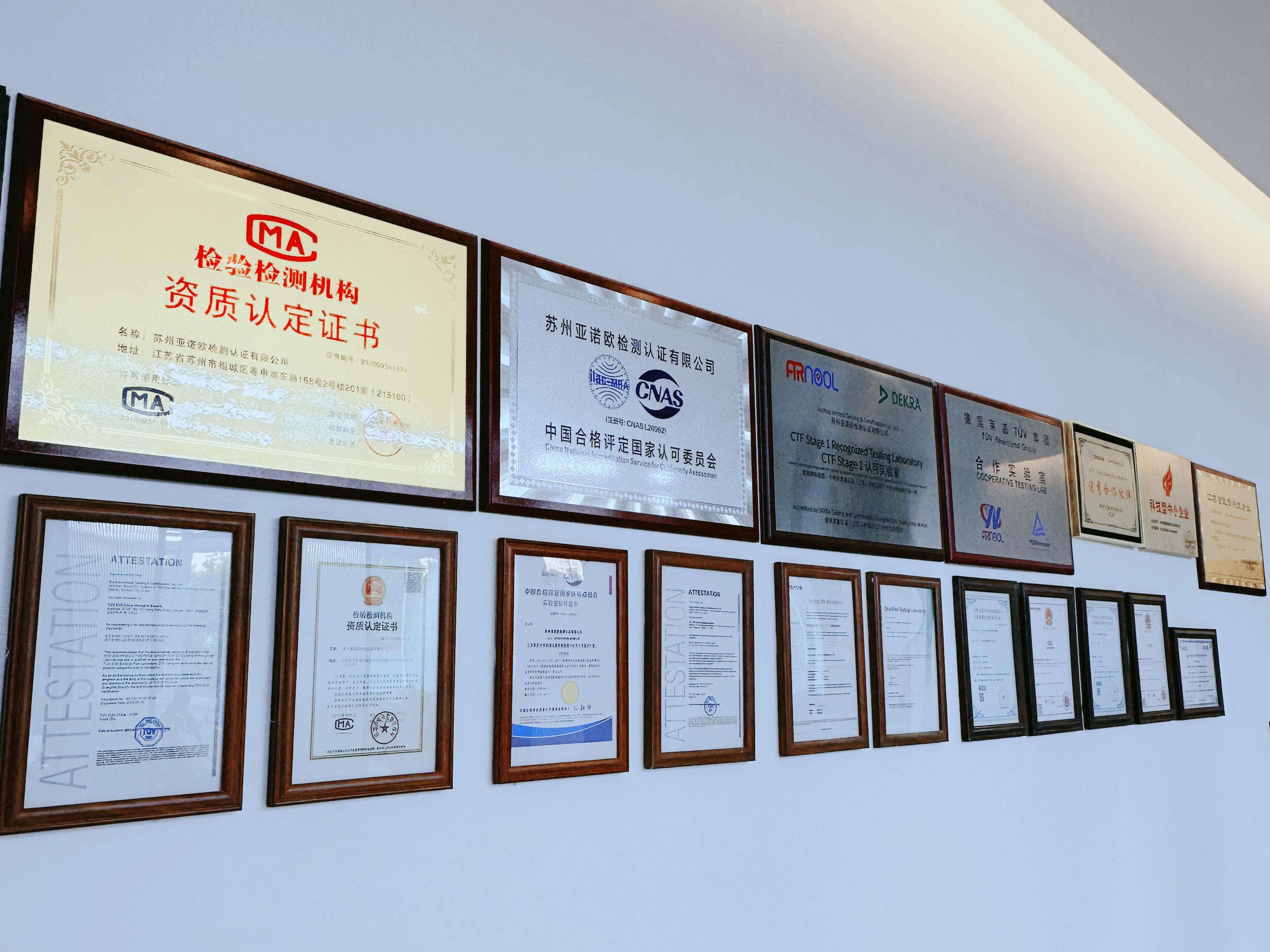
Suzhou Arnool testing and certificationprovides one-stop services globally across multiple sectors, including lighting fixtures and equipment, covering various certifications in Asia, Europe, and North America. Our professional laboratory has received international accreditation, including China’s CNAS and CMA, as well as Germany’s TUV.
Our highly capable professional team comprises experts from multiple fields and can provide support at every stage of a project. We offer customized services and develop tailored solutions to meet the specific needs of each client. As a technology-driven enterprise based in the Jiangsu-Zhejiang-Shanghai region, we provide high-quality services and respond quickly. Backed by authoritative certifications and a rigorous quality control system, we ensure that our testing results are impartial and reliable.
#Lighting Fixtures #Lighting Equipment # Home Appliances #CNAS #CMA #TUV #testing and certificationCommitted to Quality | Integrity and Trust | Impartiality and Science
-- -----------------
Follow our WeChat Official Account


Like
Save
Share